
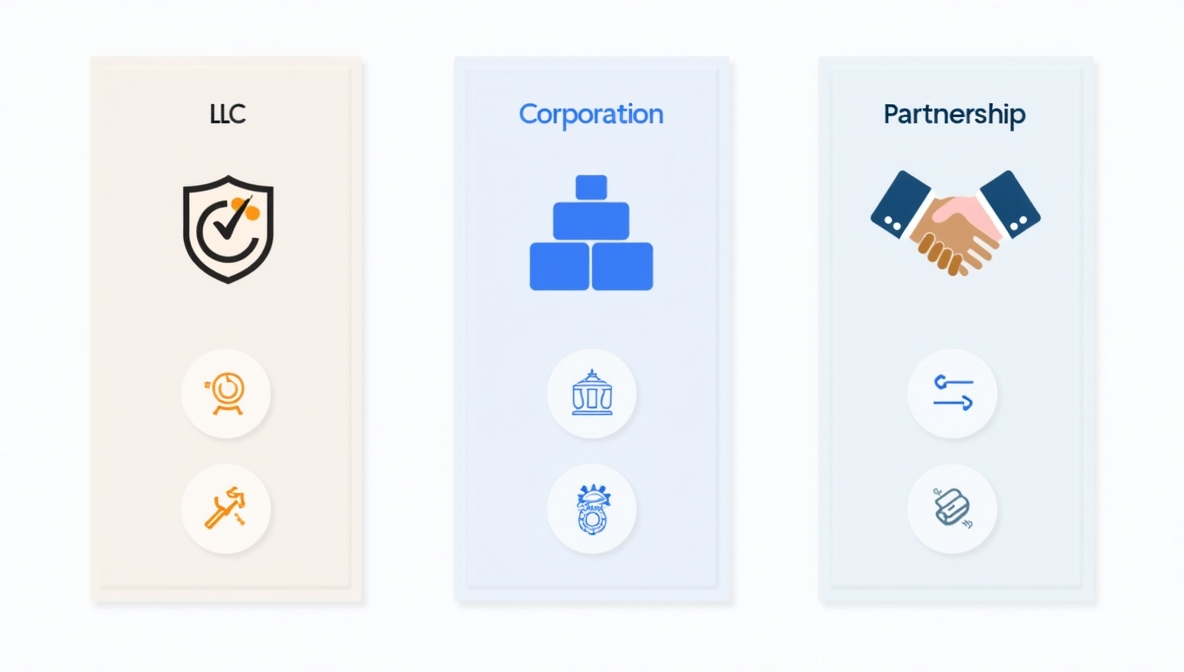
I. Overview of Business Structures
1. Sole Proprietorship
Best for: Solo entrepreneurs seeking simplicity and low cost
-
Easiest to form, often without formal registration
-
Business and owner are legally the same
-
Owner reports business income on personal taxes
-
Unlimited personal liability
2. Partnership
Best for: Two or more co-owners starting together
-
General Partnership (GP): Shared management and liability
-
Limited Partnership (LP): Some partners have limited liability and passive roles
-
Limited Liability Partnership (LLP): Liability protection for all partners (common in professional firms)
-
Pass-through taxation (profits/losses go to personal tax returns)
3. Limited Liability Company (LLC)
Best for: Small teams or individuals who want liability protection with flexibility
-
Combines corporation-style protection with pass-through taxation
-
Members (owners) are not personally liable for business debts
-
Management structure is flexible
-
Rules and fees vary by state
4. Corporation
Best for: Businesses planning to scale, raise capital, or issue stock
a. C Corporation (C Corp)
-
Separate legal entity
-
Double taxation: business income is taxed, and shareholder dividends are taxed again
-
Can issue multiple classes of stock and raise funds
-
Strong liability protection
b. S Corporation (S Corp)
-
Special tax status (pass-through like LLC)
-
Avoids double taxation
-
Must meet requirements: ≤100 shareholders, U.S. citizens/residents only
-
Liability protection similar to C Corp
II. Comparison Table of Business Structures
| Feature / Structure | Sole Proprietorship | Partnership (GP/LP/LLP) | LLC | S Corporation | C Corporation |
|---|---|---|---|---|---|
| Legal Entity | Not separate | Not separate (GP/LP), LLP is | Separate | Separate | Separate |
| Owner Liability | Unlimited | Shared or limited | Limited | Limited | Limited |
| Taxation | Personal (pass-through) | Personal (pass-through) | Default: pass-through (can elect corporate) | Pass-through (no double tax) | Double taxation |
| Formation Complexity | Easiest | Easy to moderate | Moderate | Complex | Complex |
| Compliance/Reporting | Minimal | Moderate | Varies by state | High | High |
| Best For | Simple, low-risk startups | Small teams or firms | Flexible growth | Established small businesses | High-growth startups |
| Fundraising Options | Very limited | Limited | Moderate | Moderate | Excellent |
III. How to Choose the Right Structure?
| If you want… | Consider… |
|---|---|
| Simplicity and full control | Sole Proprietorship |
| To share ownership/responsibility | Partnership or LLC |
| Liability protection and tax flexibility | LLC |
| To attract investors or issue shares | C Corporation |
| To avoid double taxation while keeping liability protection | S Corporation |